

Position
Built by the manufacturer,
not assembled by a reseller
In this category the supplier is often an importer: the cabinet, the payment stack and the software come from three different vendors, and nobody owns the failure. We engineer the cabinet, write the machine software, build the telemetry service and run the lines the machines come off — with spare parts and service in the same country.
That matters operationally: a failed vend, a stuck elevator tray or a temperature excursion is one support ticket to one team that can read the machine's own logs.
- Designed and assembled locally — no import lead time on the base unit
- Machine, payment terminal and cloud dashboard validated together before dispatch
- White-label wraps, colours, screen content and slot layout for brands and campuses
- Remote diagnostics on every unit, wherever it runs
Capabilities
What makes the machine smart
Every capability below is a production feature with a test attached to it, not a roadmap item.
UPI-first checkout
A scannable QR is the fastest path on screen, because that is how shoppers pay. Card tap-to-pay sits beside it for corporate and hospital sites.
Every common payment
UPI, RuPay, debit and credit tap, wallets and RFID badge for closed campuses and factories.
Automatic refunds
A failed vend refunds to the same UPI ID or card without an operator call. Vend detection drives the refund, not a complaint.
Slot-level stock
Every lane reports fill state, so a refill run is planned around what actually sold rather than a fixed route.
Remote pricing
Prices, menus, promotions and product swaps change over the network — no site visit, no opening the cabinet.
Sales analytics
Hour-of-day and day-of-week sell-through per machine, per slot, exported into the operator's existing reports.
IoT telemetry
Temperature, door state, motor faults, jam events, payment failures and uptime stream to the dashboard over cellular or site Wi-Fi.
API & ERP ready
Sales, inventory and settlement records publish to ERP and POS systems; fleet operations can be driven from the same API.
Formats
One platform, six cabinet formats
Capacity depends on pack size and slotting; the figures below are the envelope each format is built for.
| Compact | 80–100 products, 18 varieties, 3 trays · ambient · QR-UPI checkout · corner and small-office footprints |
|---|---|
| Snack & drink combo | 350+ products, 60 varieties, 6 adjustable trays · 4 °C to 25 °C · 10-inch touchscreen · refill alerts |
| High-capacity | 500+ products, 60 varieties · built for high daily consumption in schools, hotels and public areas · hour-by-hour sales reporting |
| Elevator / fragile | 300–350 products, 42 varieties · items lowered to the pickup bay instead of dropped · cakes, glass bottles, cups and combos · 22-inch screen |
| Beverage | 430+ cans and bottles, 24 serpentine slots · conveyor-assisted anti-theft bin · pull-out hopper for fast servicing · 21.5-inch screen |
| Frozen | −25 °C deep freeze with stable control, 270–500 products, 17–37 slots across 6 trays · cones, cups and bars · screen size configurable |
Thermal zones
Ambient, refrigerated 2–25 °C set per shelf, and deep freeze to −25 °C — the same cabinet architecture, different loop and insulation.
Slotting flexibility
Trays and spirals reconfigure for packets, bottles, cups, combos and fragile goods without changing the cabinet.
Brand surface
Full-body wraps, colours, screen content and pickup-bay finish built to a brand or campus programme.
Architecture
Six subsystems in one cabinet
Cabinet & thermal
Powder-coated steel body, insulated liner, forced-air refrigeration with a defrost cycle, and temperature logging independent of the sales controller.
Dispensing
Spiral lanes, serpentine beverage chutes, elevator trays for fragile goods and a conveyor-assisted anti-theft pickup bin, each with jam and vend detection.
Payment
Certified card terminal, UPI intent QR on the HMI, wallet and RFID readers, with settlement pushed to the operator's bank account and an immutable transaction log.
Compute & HMI
Embedded controller running the sales application behind a 10 to 22-inch touchscreen; the UI is a product surface, so menu layout and speed are engineering work.
Connectivity
Cellular and site Wi-Fi with a store-and-forward queue: sales, stock and fault telemetry survive network loss and reconcile when the link returns.
Security & service
Separate cash/mechanical and electronics locks, door-open event alerts, tool-less module access for servicing, and pull-out hopper on beverage formats.
| Display | 10 / 13 / 15 / 21.5 / 22-inch touchscreen, portrait menu or grid layout |
|---|---|
| Trays | 3 to 6, adjustable lane pitch, spiral or elevator delivery |
| Capacity | 80 to 500+ units per fill depending on format and slotting |
| Varieties | 18 to 60 SKUs per fill |
| Temperature | Ambient · 2 °C to 25 °C refrigerated · −25 °C frozen |
| Payments | UPI QR intent, RuPay/Visa/Mastercard tap and swipe, wallets, RFID badge |
| Network | Cellular and Wi-Fi, store-and-forward queue, remote diagnostics |
| Power | Single-phase mains; compact ambient formats draw under one unit of consumption per day |
| Finish | Custom wrap, colour, screen content and pickup-bay trim |
Failure handling is the product
- Vend confirmed by sensor, not by motor command — a jam triggers the refund path.
- Temperature excursion raises an alert before stock is at risk, and logs the event for food-safety records.
- Offline mode keeps selling; transactions reconcile when the link is back.
- Firmware and menu changes ship as signed images with rollback.
- Every fault code maps to a service action, so a technician arrives with the right part.
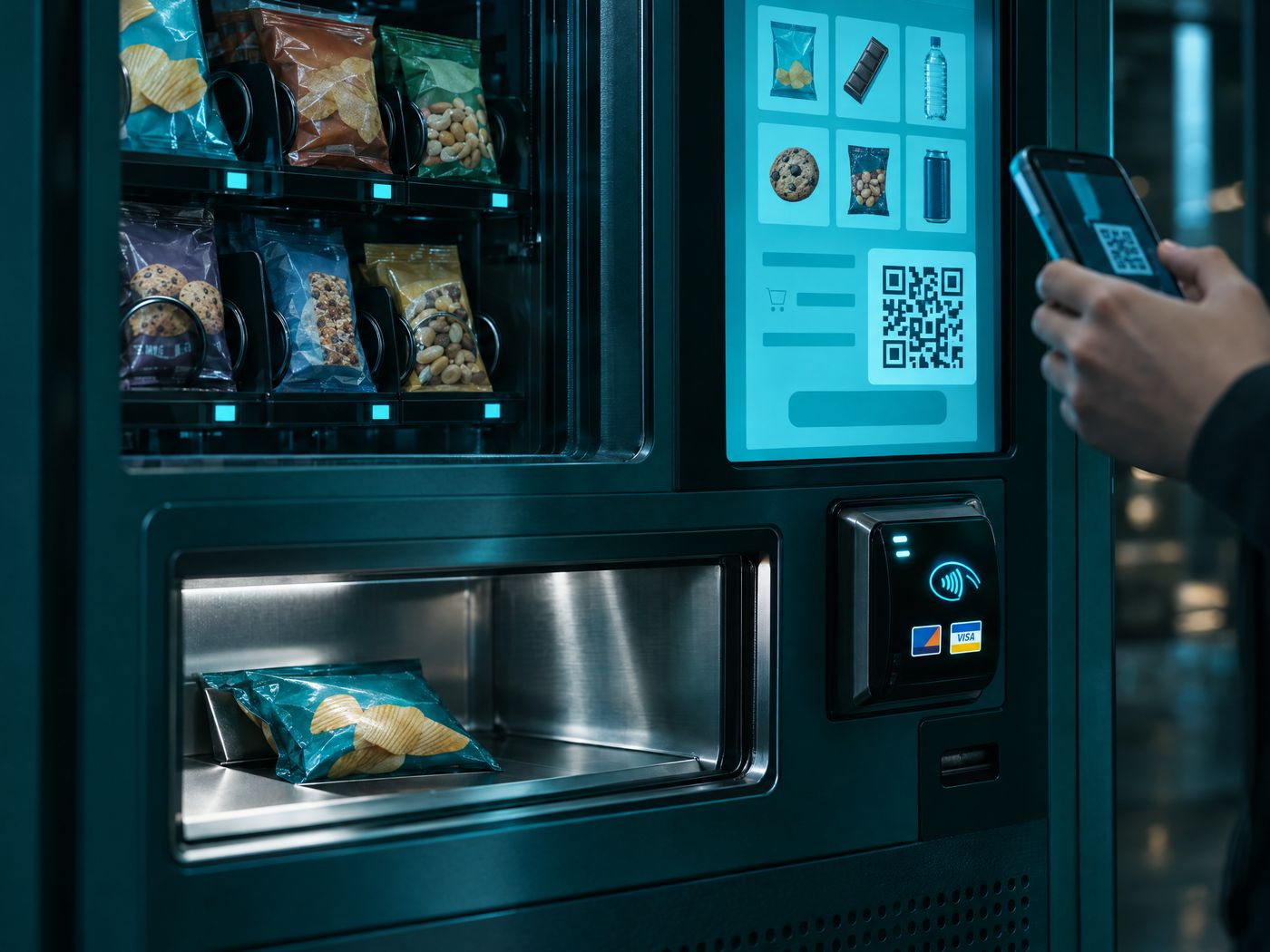
Checkout & settlement
The payment path is the conversion path
Shoppers in India scan far more often than they tap a card, so the QR has to be the fastest route to a product — visible at eye level, resolved in seconds, with no app install. Cards and wallets remain first-class for offices, hospitals and transit sites where the shopper already holds one.
- UPI intent QR rendered on the machine's own screen, price and order bound to the session
- Contactless card and RuPay tap, swipe fallback, wallet and closed-campus RFID badge
- Settlement pushed to the operator's bank account with a per-transaction audit trail
- Failed, cancelled and unserved transactions reversed automatically to the source
- Cash-free by default; cash acceptance available for formats that need it
Payment acceptance runs on certified terminals; acquirer, card-scheme and network-specific requirements are confirmed per deployment before go-live.
Operations software
One dashboard for the whole estate
Live state
Sales, stock per lane, machine health, temperature and door events across every site on one screen.
Refill planning
Alerts when a lane drops below a threshold, sequenced into routes so popular items do not run out mid-day.
Assortment
Hour-of-day sell-through per machine feeds slot changes, pricing and which SKUs belong in which site type.
Money & reconciliation
Transaction ledger, settlement reports and refund register exported to finance and ERP systems.
Fleet control
Signed remote updates for firmware, menus and prices, with role-based access per operator and per site.
Service desk
Fault codes, tickets and technician coverage tied to the machine's own diagnostic log.
Built for operators, not demos
The workflow that matters is the one at 7 a.m. before the first footfall: what needs restocking, what broke overnight, and which site is about to run out of the item that sells. Everything on this machine's software side is designed around answering those three questions without driving anywhere.
Integrations
ERP, POS and BI via REST APIs; product master and pricing sync from the retailer's system of record.
Roles
Operator, route, finance and service roles with per-site permissions and an audit trail on every change.
White label
Dashboard, receipts and screen content carry the operator's brand across the estate.
Resilience
Store-and-forward telemetry and local caching mean a site outage never stops a sale.
Where they work
Site types we build and deploy for
Manufacturing & test
How a cabinet is proven before it is delivered
Unattended retail hardware fails publicly, at 2 a.m., with a customer watching. The line reflects that: every unit runs loaded, hot and offline before it ships.
Cabinet & body
Laser-cut and folded steel, welded, deburred, powder-coated; insulation and door alignment checked against gasket compression.
Refrigeration
Loop pressure and leak test, charge verification, then a pull-down run to setpoint with logged compressor current.
Dispensing
Duty-cycle test on every lane type — spiral, serpentine, elevator and conveyor bin — counted to the vend target.
Payment
Terminal enrolment, live UPI and card transactions executed on the unit, refund path forced and verified.
Loaded soak
72-hour soak at working temperature with the machine stocked, cycling doors, defrost and network drop events.
Electrical & EMC
Dielectric withstand, earth continuity, leakage, harmonics and emissions screening on production units.
Software release
Signed firmware and menu image flashed at the line; checksum, serial and configuration written to MES.
Delivery gate
Pallet, crate, install kit, network provisioning pack and the unit's own test record travel with it.
Compliance handled as engineering
- Electrical safety and EMC scope confirmed per format before first shipment.
- Food-contact and cold-chain requirements reflected in liner, drainage and temperature logging (FSSAI-facing practices for what the machine sells).
- Packaged goods sold through the machine carry the declarations required under Legal Metrology — the machine displays and records them, it does not override them.
- Payment acceptance only on certified terminals, with per-deployment acquirer and scheme checks before go-live.
- E-waste producer responsibility and hazardous-substance declarations managed at the SKU level.
72h
Loaded soak per unit
100%
Lanes vend-tested at end of line
6
Cabinet formats on one platform
24h
Support response commitment
Buyer's checklist
Six questions to ask any vending supplier
Asked before the brochure, these six answers separate a manufacturer from an importer — and predict what the next three years of operations feel like.
Who builds it
Is the cabinet manufactured locally or imported, and where do spare parts come from when a lane seizes on a Tuesday?
Payments
Is UPI QR the fastest path on screen, with RuPay and card tap available for corporate and hospital sites?
Remote monitoring
Can you see stock, sales and faults live, and change a price without driving to the site?
Refunds
Does a failed vend refund automatically to the same payment source, or does the operator chase it?
Compliance help
Does the supplier know the food-safety and packaged-goods labelling rules for what the machine sells?
Service reach
Response time, technician coverage in your city and warranty terms — in writing, per site.
Deployment
From site survey to first sale
Site & assortment
Footfall pattern, power and network availability, placement line of sight, and the product mix the format should carry.
Configuration
Format, thermal zone, tray slotting, screen content, wrap, payment methods and settlement account locked per machine.
Build & prove
Line build, loaded 72-hour soak, live transactions, then the test record and serial leave with the unit.
Install & enrol
Levelling, anchoring, network join, terminal enrolment and telemetry enrolment so the machine reports before the first vend.
Operate
Refill routes, price changes, promotions and reports from the dashboard; remote diagnostics when something does not sell.
Scale
Rollout playbooks by site type, spare-part kits held in-country, and multi-site estates managed on one platform.
Questions
Specification notes
Plan a pilot or a rollout
Send the site type, footfall and product category. We will come back with the format, slotting plan, network requirement and a deployment timeline.